CLI-native agent execution
Spawn Claude Code, Codex, Antigravity CLI (`agy`), Cursor CLI (`agent`), and OpenCode as governed workflow agents with inherited MCP servers.
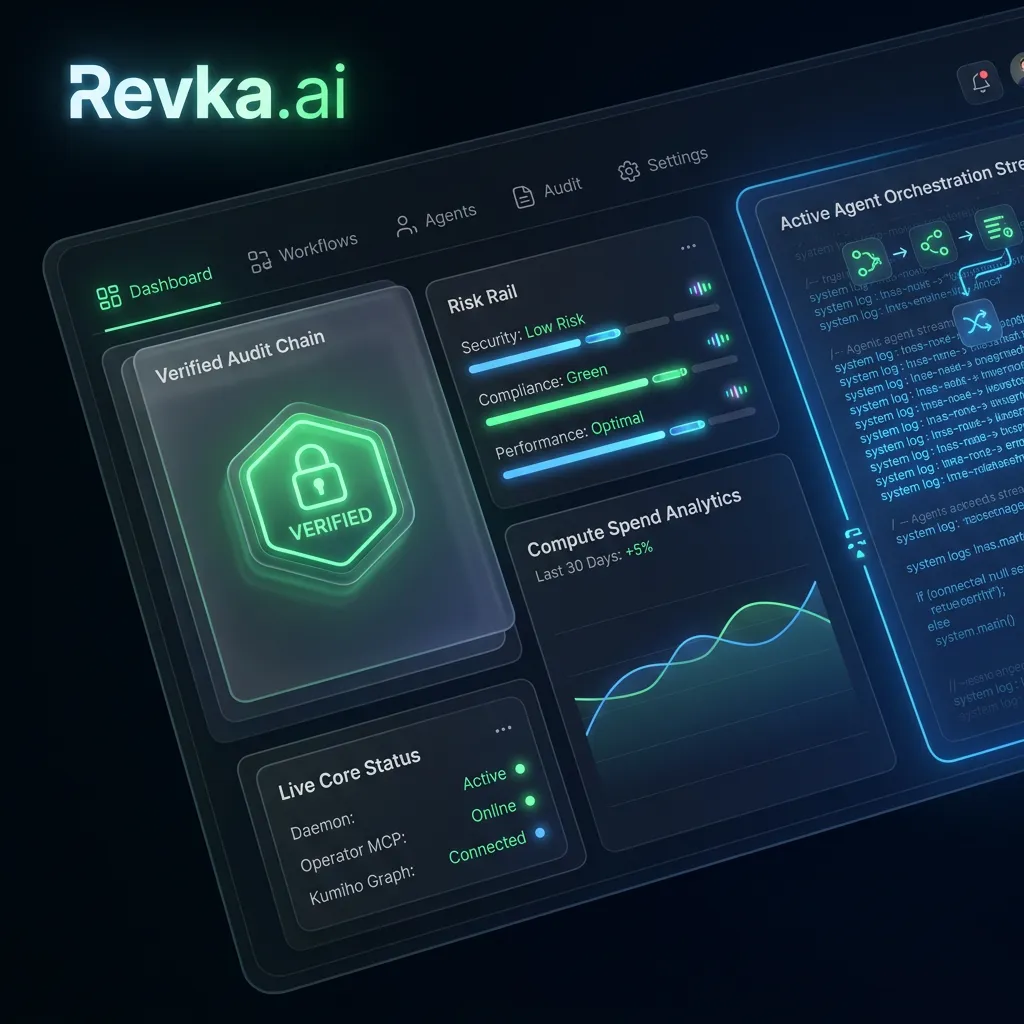
Graph Engineering for AI Agents
Revka connects the graph your agents execute with the graph they remember. Design explicit workflows, preserve every revision and provenance edge, trigger new work from graph state, and keep the evidence when the system reaches production.
Spawn Claude Code, Codex, Antigravity CLI (`agy`), Cursor CLI (`agent`), and OpenCode as governed workflow agents with inherited MCP servers.
Run locally, work as a solo builder or small team, and keep a clean path to managed graph memory, service controls, diagnostics, and Enterprise self-hosting.
Merkle hash-chain audit, `/api/audit/verify`, approval records, RunLog JSONL, and visible risk rails are product surfaces, not afterthoughts.
A production agent system has several graphs at once: the work it executes, the knowledge it carries forward, the evidence it leaves behind, and the feedback that changes what happens next. Revka makes those graphs explicit and connects them instead of hiding them in prompts, chat history, and ad hoc glue code.
Read the Graph Engineering guideTyped workflow steps, dependency edges, conditional routes, guarded loops, parallel joins, map-reduce, supervisors, handoffs, and human gates.
Immutable revisions, artifacts, typed provenance edges, sessions, goals, skills, outcomes, and trust records in Kumiho graph memory.
Run state, per-agent JSONL, approvals, hashes, costs, tool calls, and a verifiable Merkle audit chain connect decisions to outcomes.
Revision tags can fire downstream workflows, while outcomes and trust signals inform later delegation and controlled improvement loops.
Revka is useful before a procurement process exists: local-first workflows, CLI-backed agents, and graph memory make it practical for personal automation and small teams. When the same work becomes critical, Revka already has the records an organization expects: who initiated it, which agent ran it, what tools were called, what approvals were required, what artifacts changed, and what revision should be used next.
Revka Operator spawns real coding CLI subprocesses inside declarative workflows. Each agent can carry a persona, role, tool allowlist, timeout, and model override, while Revka injects the MCP servers and records the operational trail.
Use Claude Code sessions for high-context implementation, review, and operator-supervised coding tasks.
Route codebase work through Codex agents with scoped tools, model choices, and workflow-level evidence capture.
Delegate specialized implementation or exploration steps to Antigravity CLI through the `agy` agent type.
Run Cursor CLI as the `agent` runtime when teams want Cursor-native execution under Revka governance.
Use OpenCode CLI for coding work that benefits from its own agent loop, while Revka owns orchestration and audit.
Revka combines orchestration, observability, policy, and memory in one runtime surface. Operators can author YAML workflows, execute them, inspect live events, drill into RunLogs, retry or approve work, and preserve the exact context for the next run.
Declare steps for agent runs, shell and Python execution, human approval and input, parallel and map-reduce fan-out, supervisor and group-chat coordination, handoffs, and structured output.
Watch WebSocket events, run state, selected step output, tool calls, agent activity, command band status, recent runs, spend, and component health.
Store workflows, outputs, artifacts, sessions, goals, teams, skills, trust records, and provenance in graph memory with revision-level continuity.
Use approvals, checkpoints, retries, diagnostics, service controls, E-Stop, workspace boundaries, prompt guard, and secret scanning around real agent work.
Enterprise agent systems need evidence, not screenshots of a final answer. Revka records runtime events and exposes verification surfaces so teams can prove what happened, inspect why it happened, and continue from the correct state.
9f2c…41aa #1025c7d1…08be #10265e93…b6f0 Chain verified /api/audit/verify Every runtime event is appended to a Merkle hash chain; the chain can be re-verified at any time.
{"ts":"04:18:02Z","event":"message","agent":"claude","step":"plan"}
{"ts":"04:18:09Z","event":"tool_call","tool":"shell.run","exit":0}
{"ts":"04:18:31Z","event":"approval","actor":"operator","decision":"approved"}
{"ts":"04:18:32Z","event":"result","status":"ok","hash":"sha256:9f2c…41aa"}
Messages, tool calls, approvals, and results land in queryable JSONL — one trail per agent run.
Human approval and human input steps are typed workflow steps, with approval decisions recorded instead of disappearing into chat history.
Agent trust scores, revision tags, Kumiho provenance edges, and artifact history keep every output connected to its operational lineage.
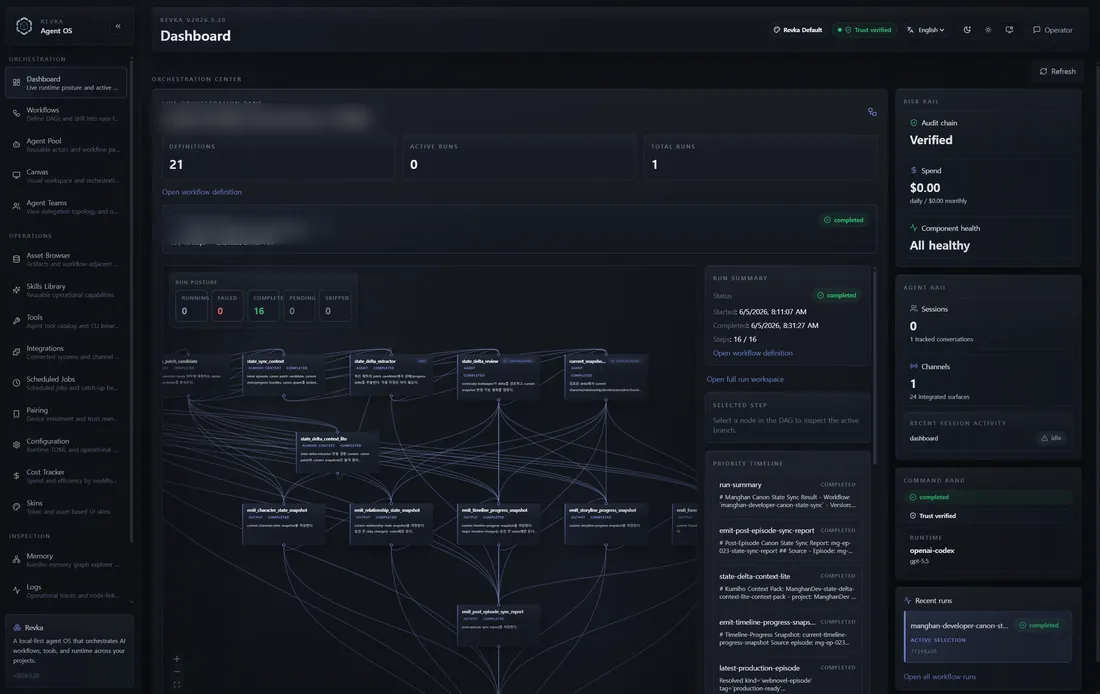
The central operational hub of your agent ecosystem. Track active run sessions, real-time agent memory, API token spend, cluster resource health, and system-wide security posture at a glance.
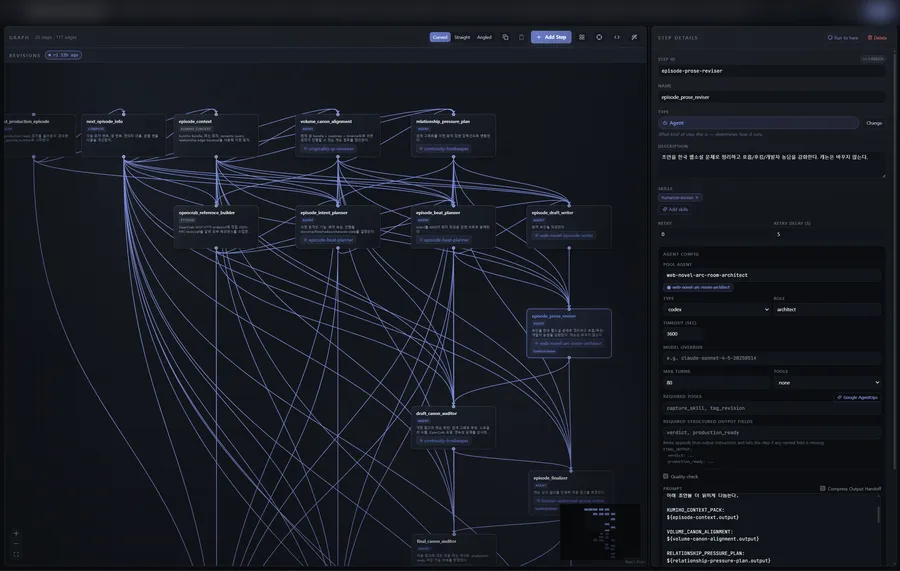
Design robust multi-agent flows with a drag-and-drop workspace or side-by-side YAML authoring. Configure step-level inputs, secret injection, allowed tools, and human-in-the-loop checkpoints.
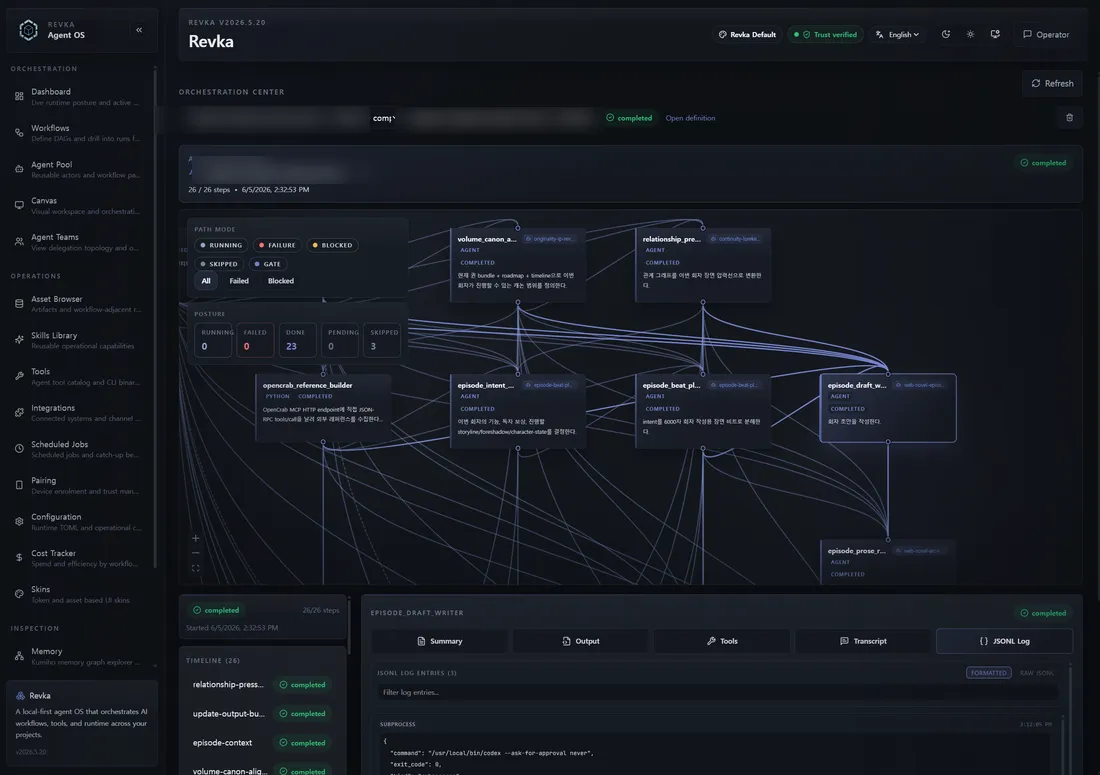
Monitor tasks as they compile and run. Drill into step outputs, view stdout streams, approve model-recommended actions, and watch parallel reviewer agents collaborate in real-time.
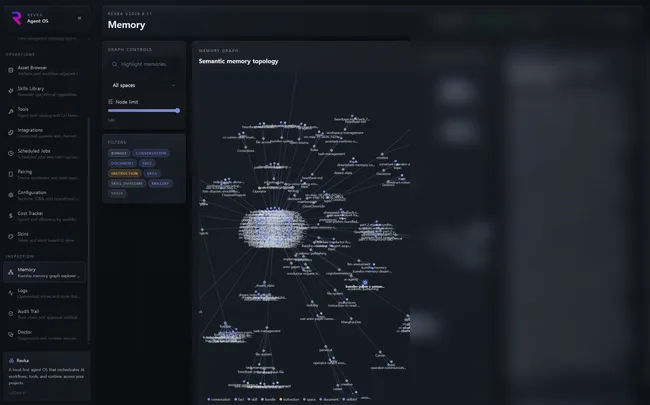
Navigate connected facts, user sessions, instructions, code revisions, and agent trust signals. Understand semantic provenance tracking to see exactly how and why a memory was generated.
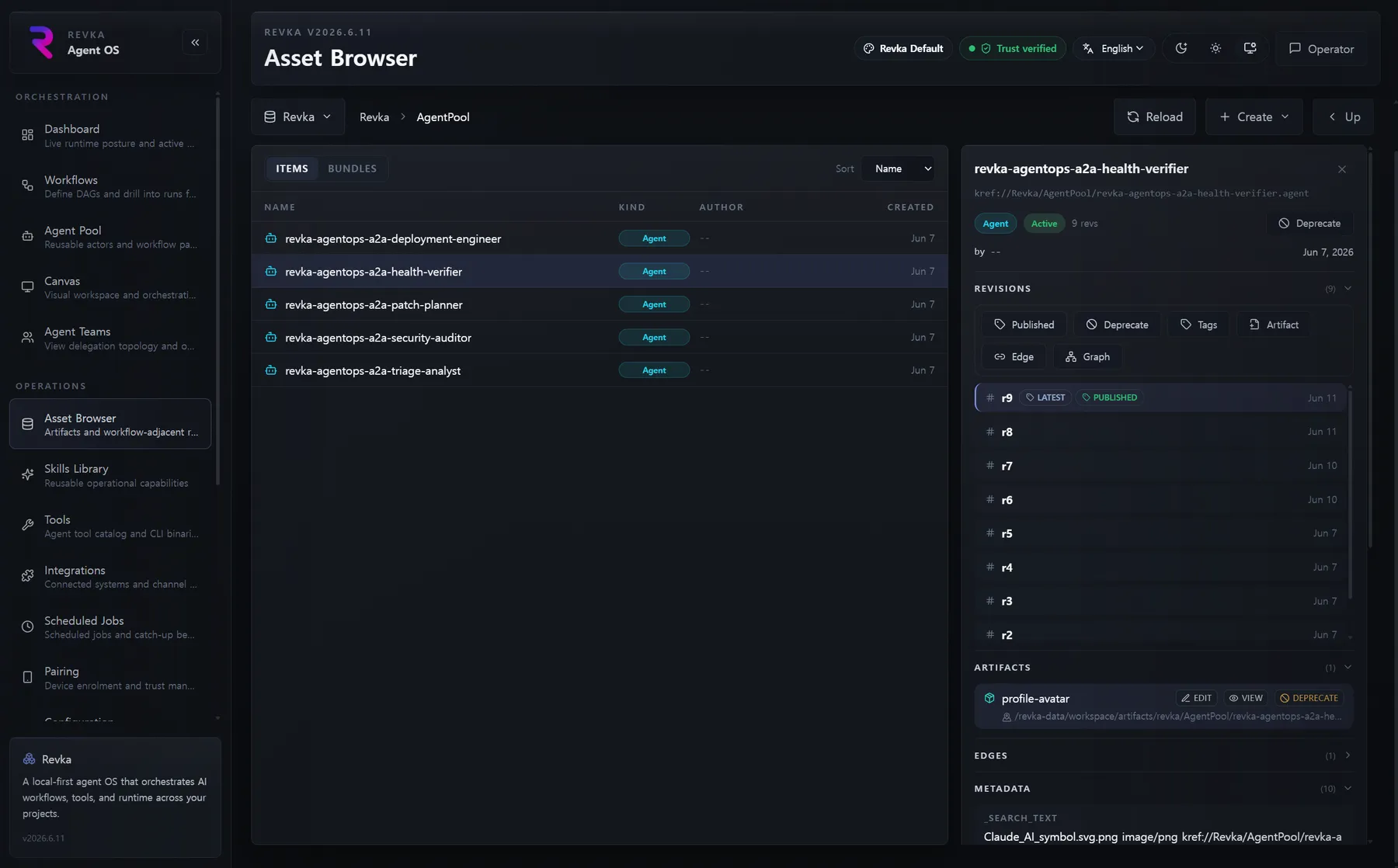
Inspect, manage, and download all generated files, code diffs, structured JSON outputs, and runtime bundles. Each asset is cryptographically hashed for tamper-evident verification.
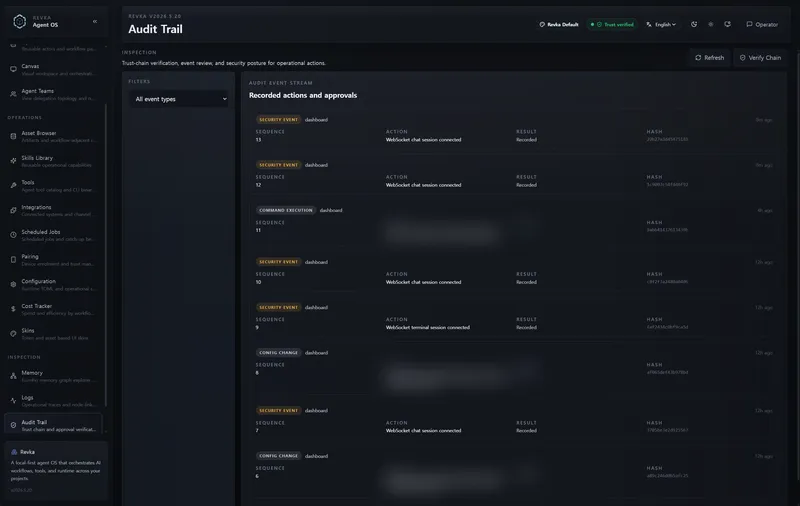
Query cryptographically chained logs built for non-repudiation. Every message, tool call, shell command, and manual approval is hashed and verifiable under security review.
Revka is the enterprise agent runtime surface. Operator executes declarative workflows. Kumiho provides the versioned graph memory backend that keeps runs, revisions, trust, and provenance traceable across sessions.
Rust-native gateway, daemon, CLI, channels, tools, dashboard, local service control, diagnostics, metrics, and audit surfaces.
Python orchestration server for workflow validation, lifecycle management, execution, events, RunLogs, approvals, and agent process control.
Version-controlled, schemaless, typed-edge graph memory for artifacts, workflow runs, sessions, provenance, revisions, and agent trust.
The deployment path keeps Revka responsible for workflow state, approvals, logs, artifacts, rollback evidence, and governance while Google Agents CLI handles ADK lifecycle work and A2A makes the deployed agent discoverable across enterprise ecosystems.
Google Agent Development Kit (ADK) is a production-grade framework for building, evaluating, and deploying agents. Revka wraps ADK execution and evaluation with Merkle hash-chain logging and Kumiho's versioned memory graph, so ADK workloads arrive at security review with their evidence already in order.
Personal power users and builders who want local-first agent workflows without giving up history, memory, and repeatability.
Small teams turning useful automations into shared workflows with approvals, cost posture, and operational ownership.
Platform teams supervising Claude Code, Codex, Antigravity CLI, Cursor CLI, OpenCode, Google ADK tooling, and A2A agents through repeatable runs.
Enterprise operators who need provenance, security review evidence, deployment choices, and memory continuity.
Revka turns agent orchestration into a verifiable operational system without making the first workflow feel heavy: governed execution, audit-first visibility, and graph memory that remembers the actual work.
git clone https://github.com/KumihoIO/Revka.git  Revka
Revka